All 10 of the top-selling 2020 car models are clearly connected online to safety critical systems and cannot be disconnected, leaving automobiles vulnerable to an unprecedented, large-scale hack, according to a new finding by the nonprofit group Consumer Watchdog.
The advocacy group reviewed technical specifications and surveyed dozens of sales departments and service technicians at major car manufacturers.
All of Car and Driver’s top 10 best-selling cars for 2020 clearly have features that allow Internet connectivity with safety critical systems and no known way to disconnect those systems.
Consumer Watchdog also found that many dealership employees misrepresented that critical safety systems of top selling models are linked online and the dangers of such connections.
The report follows revelations by Consumer Watchdog and car industry technologists over the unaddressed perils of security systems in “connected cars.” Sales departments, the pivotal link to the public about a car’s performance, were ill-informed about whether critical systems of the car were accessible from outside the vehicle, leaving them prone to hackers. A critical component is often the vehicle’s CAN bus, or Controller Area Network, which links the car’s critical components, such as brakes and engines, and can be accessible to hackers through a cellular or satellite connection. Many salespersons and service technicians surveyed by Consumer Watchdog said they were not familiar with the component, or misrepresented it and said it wasn’t connected to the Internet.
In most cases, the advertised capabilities of the car–for example, the ability to start the engine remotely–proved the point that the cars’ safety critical systems were connected wirelessly. Nonetheless, sales representatives misrepresented or obfuscated that connectivity.
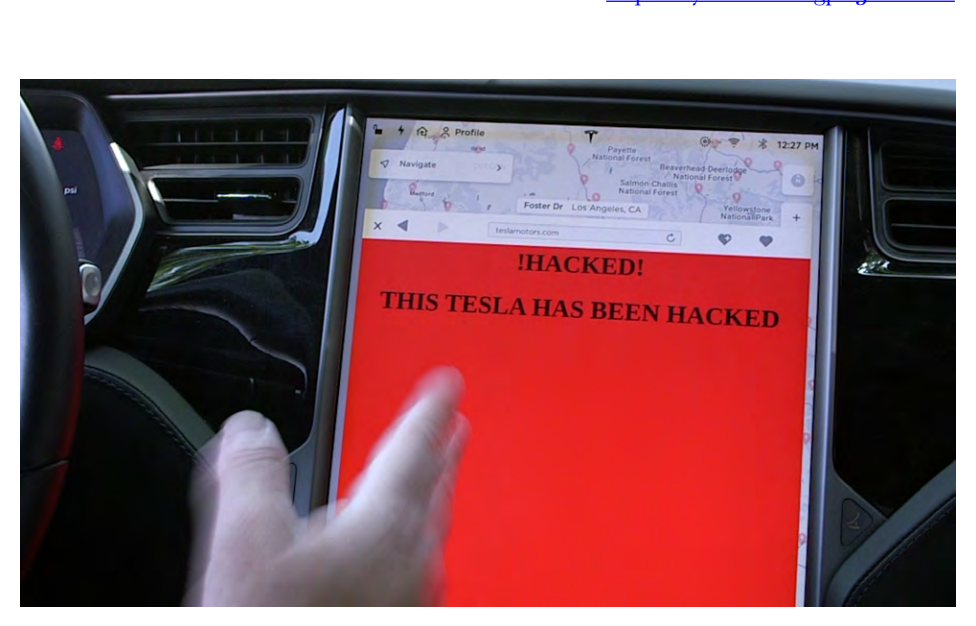
Most critically, dealerships said they would not be able to take vehicles offline. When safety critical systems–brakes, engine, steering–are connected wirelessly there is the possibility of that connection being hacked on a fleet-wide basis. This danger is outlined in Consumer Watchdog’s previous report, “Kill Switch: Why Connected Cars Can Be Killing Machines and How To Turn Them Off.” ( https:// www.consumerwatchdog.org/sites/default/files/2019-07/ KILL%20SWITCH%20%207-29-19_0.pdf (opens in new tab)) To dramatize the fact, with the help of technologists, Consumer Watchdog built a simple box that hijacks a Tesla’s cellular connection.
When the Tesla connected to the box, Consumer Watchdog was able to take over the screen of the car and send signals to it, mimicking messages that might come from Tesla. A video of the demonstration can be found here: https://youtu.be/ RgpmJ6OhPns (opens in new tab) In July 2017, Tesla CEO Elon Musk professed that the biggest danger of autonomous car technology was a “fleet wide hack.” In August 2020, it was reported that just months before that 2017 statement Tesla had faced a fleet wide hack, but failed to reveal it to the public or regulators. Instead, it paid the white hat hacker off and kept the incident quiet. Read the story at https://electrek.co/ 2020/08/27/tesla-hack-control-over-entire-fleet/ (opens in new tab) The demonstrations reflect the dangers of wireless connections to cars’ safety critical systems and the failure of the car industry to create safe designs to deal with it.
The following are findings about popular 2020 models based on Car & Driver’s top selling models of 2020.
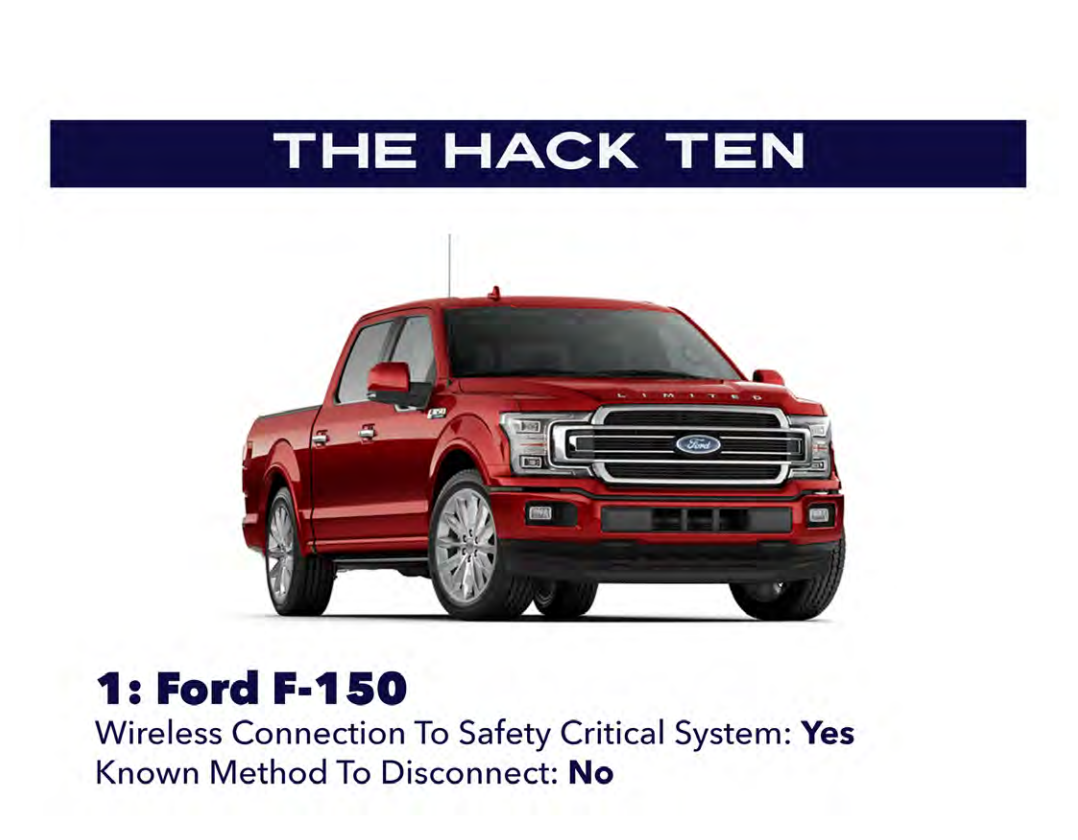
Online, dealers advertise (opens in new tab) the 2020 Raptor as having FordPass Connect, 4G Mobile Hotspot Internet Access, and premium remote start options. The remote start option necessitates a wireless connection to the safety critical systems of the car. If the engine of the car can start remotely, it can be hacked remotely.
Surveyed employees at the Sam Leman Ford in Bloomington, Illinois were not sure if the most popular selling car in the United States was connected online to the car’s CAN bus. Kyle, an employee in the sales department, said “the only thing that controls the brakes is the ABS.” Morgan, another employee, said SYNC Connect, the vehicle’s infotainment system, was linked up to “everything in the truck,” allowing owners to start, lock or unlock vehicles at any time. However, he wasn’t “too sure about the CAN unit itself.”
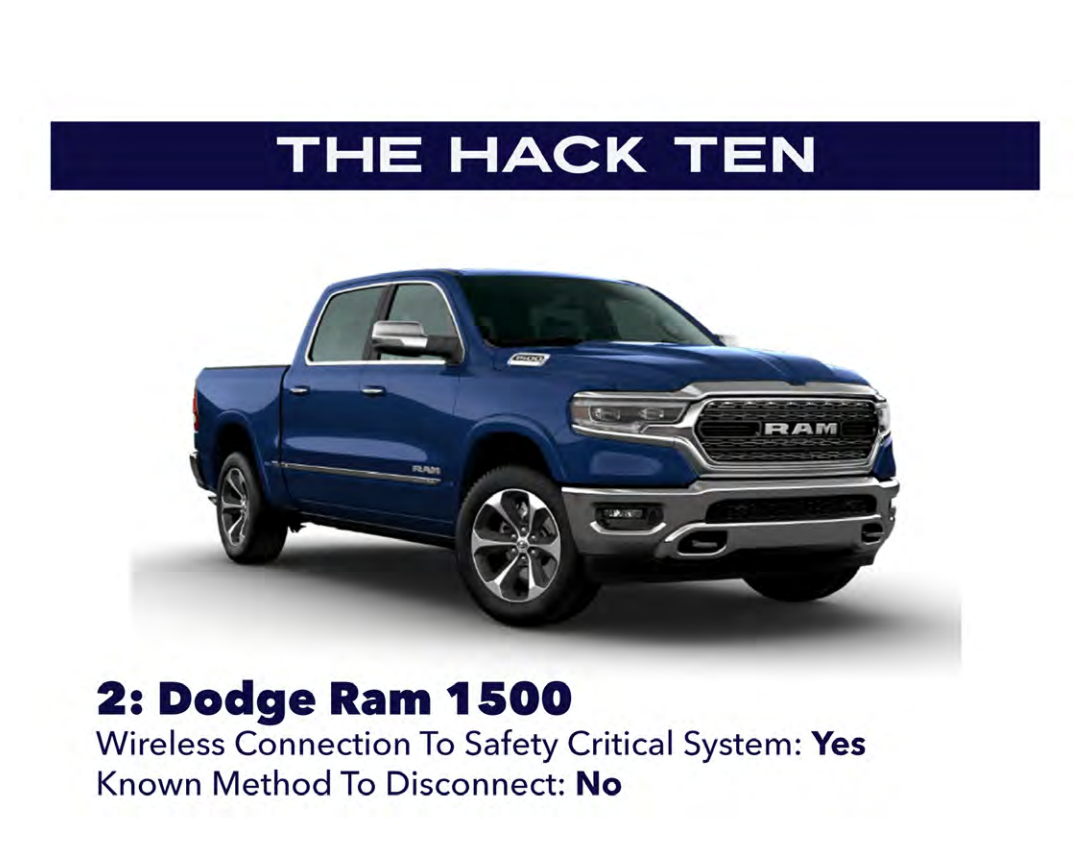
Dodge dealerships advertise (opens in new tab) the new model as having “smart device integration,” “remote engine start” and “UConnect,” which allows for remote system updates. Technologists say these systems necessitate wireless connectivity to safety critical systems.
Employees at Dodge dealerships confirmed there is an app allowing the car to remotely trigger the vehicle’s functions, but downplayed insecurity to the vehicle from such a connection.
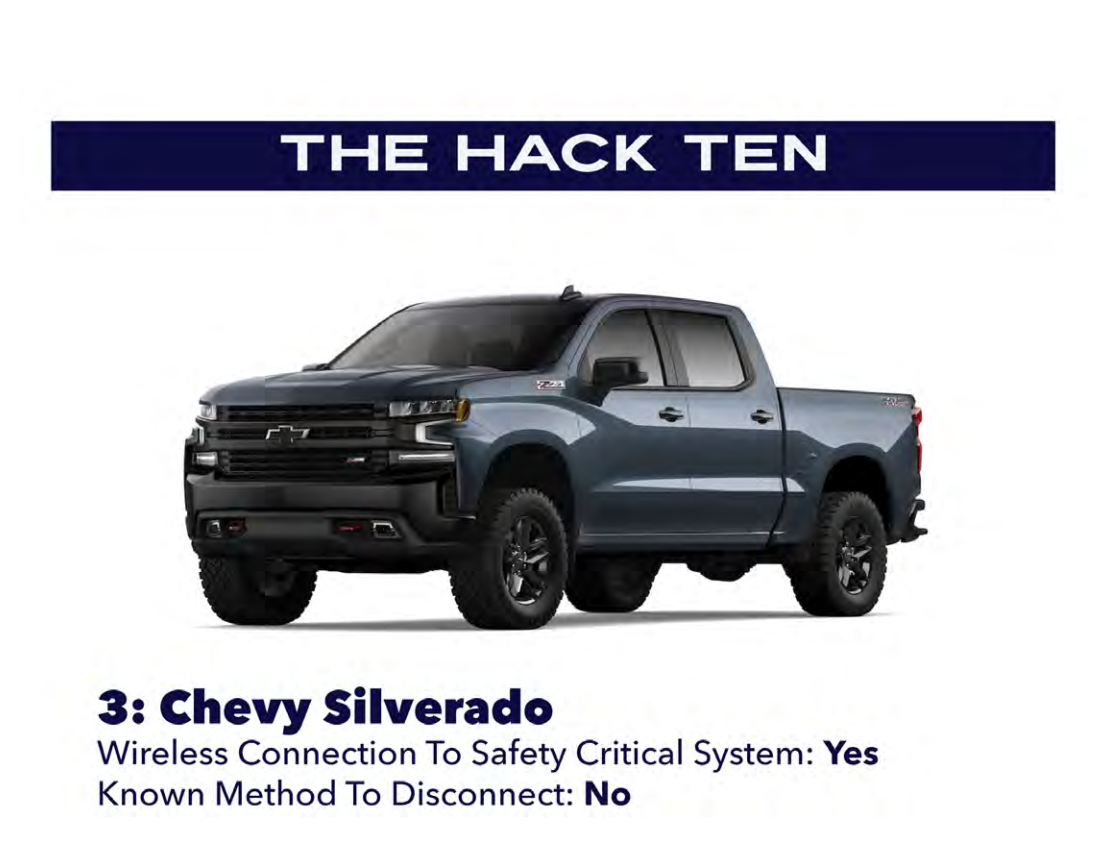
A member of the service department at Chevrolet Wickstrom (opens in new tab) named Brody said she was not sure if the Silverado’s infotainment system was connected to the CAN bus. The employee pointed to a subscription-based application that goes through Onstar, allowing users to remotely access the vehicle.
Such remote access connections create vulnerabilities to hacks.
Asked if the car could be taken offline, the employee said, “I wouldn’t know how to go about. I don’t know if we have the capabilities to do something like that.”
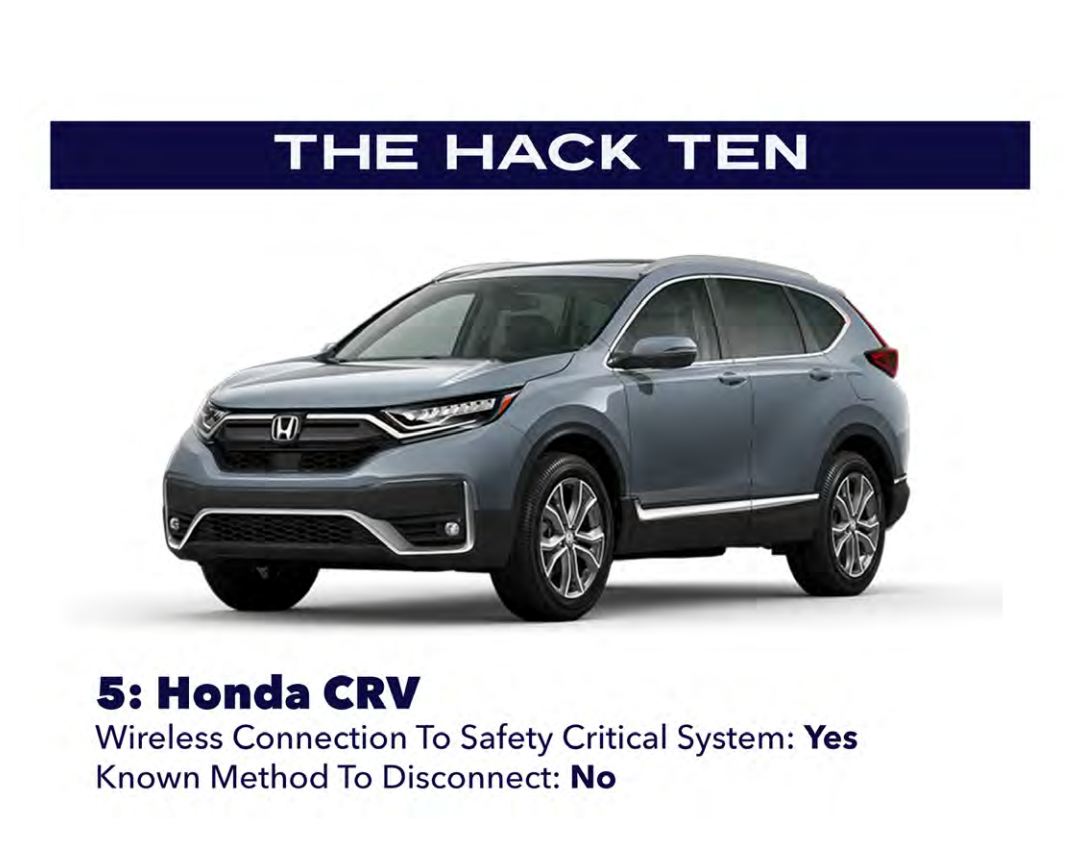
A Schaumburg Honda dealership said their 2020 model (opens in new tab) is indeed connected online through HondaLink. “We’re able to connect through the CAN. The infotainment system is connected to that,” said a Honda Schaumburg employee. However, taking it offline is “not something we would do, not something we have heard of.”
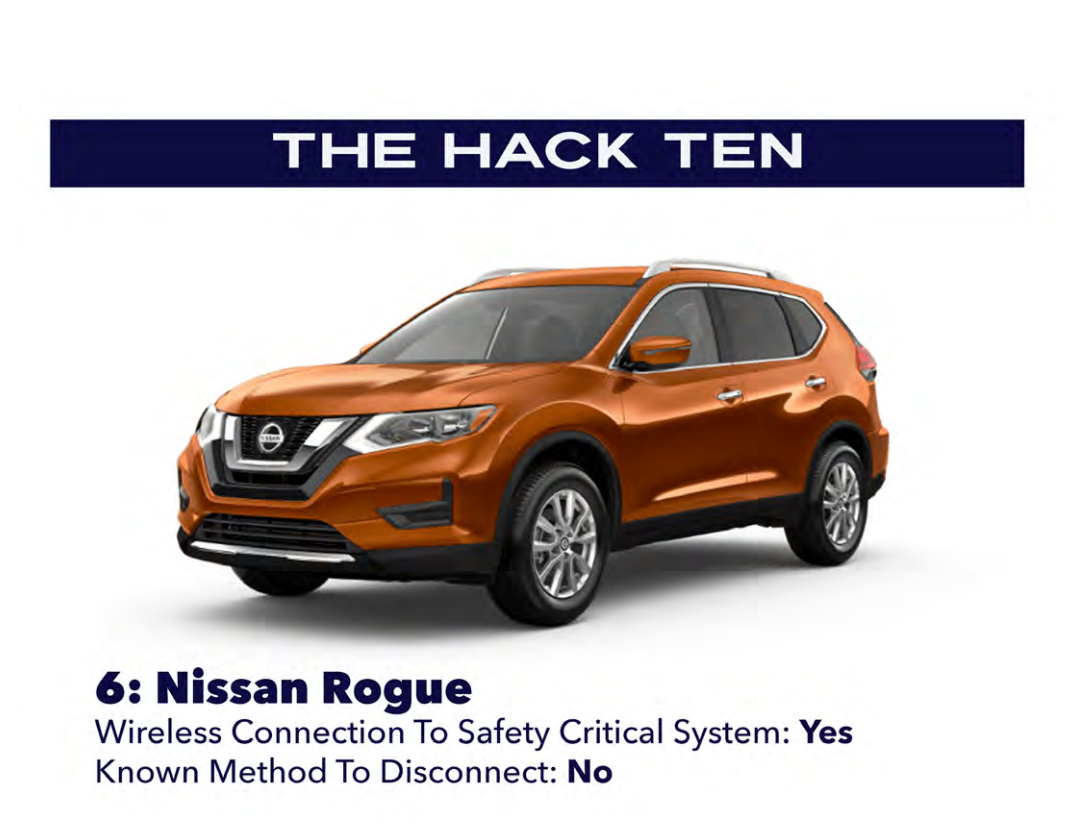
Online advertisements (opens in new tab) for the Rogue SV indicate connectivity features such as remote engine start. Lower models, such as the Rogue S, do not. Higher end 2020 models have remote start technology but are not connected to the CAN bus, according to a Glendale Nissan employee.
The Rogue S, however, doesn’t have remote technology, said one employee.
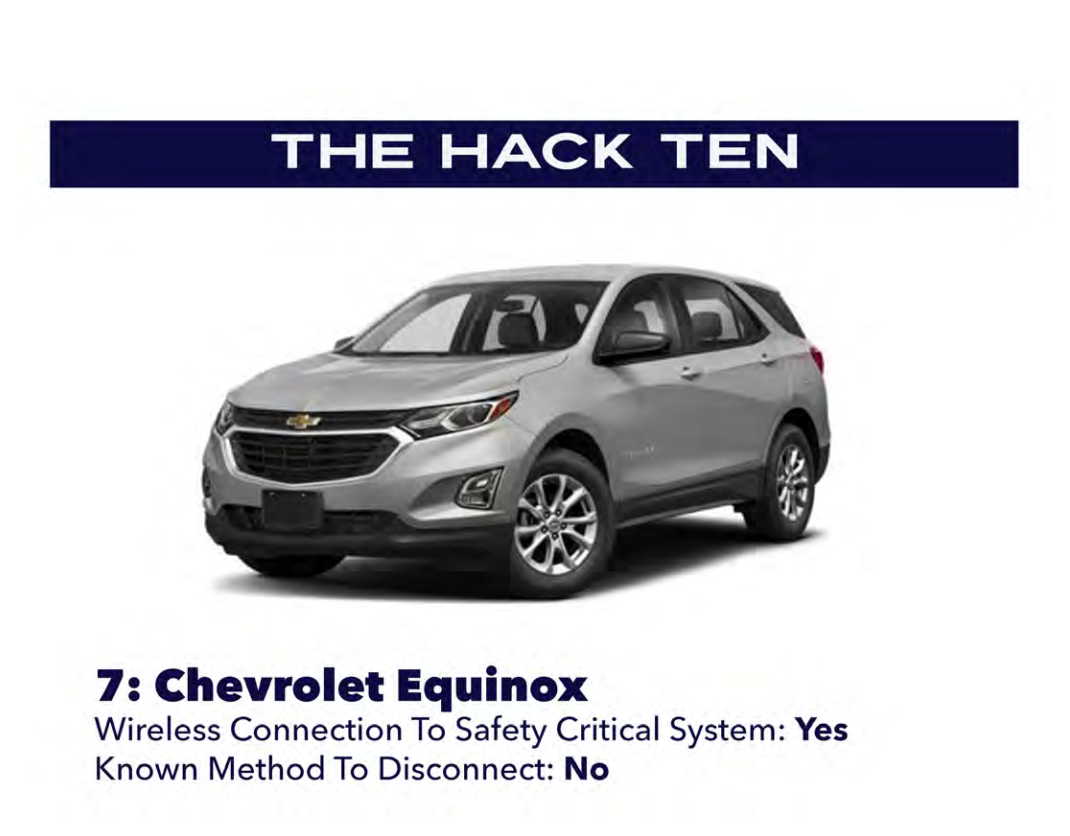
A service technician at Leman’s Chevy City confirmed that the Internet is connected to the Equinox, including to its CAN bus. “Yes sir, quite a bit tied to that system,” said the employee. As for disconnecting online connectivity, he said, “I don’t know if it’s possible.”
The dealership advertised the model (opens in new tab) as coming with OnStar and Chevrolet Connected Services capabilities.
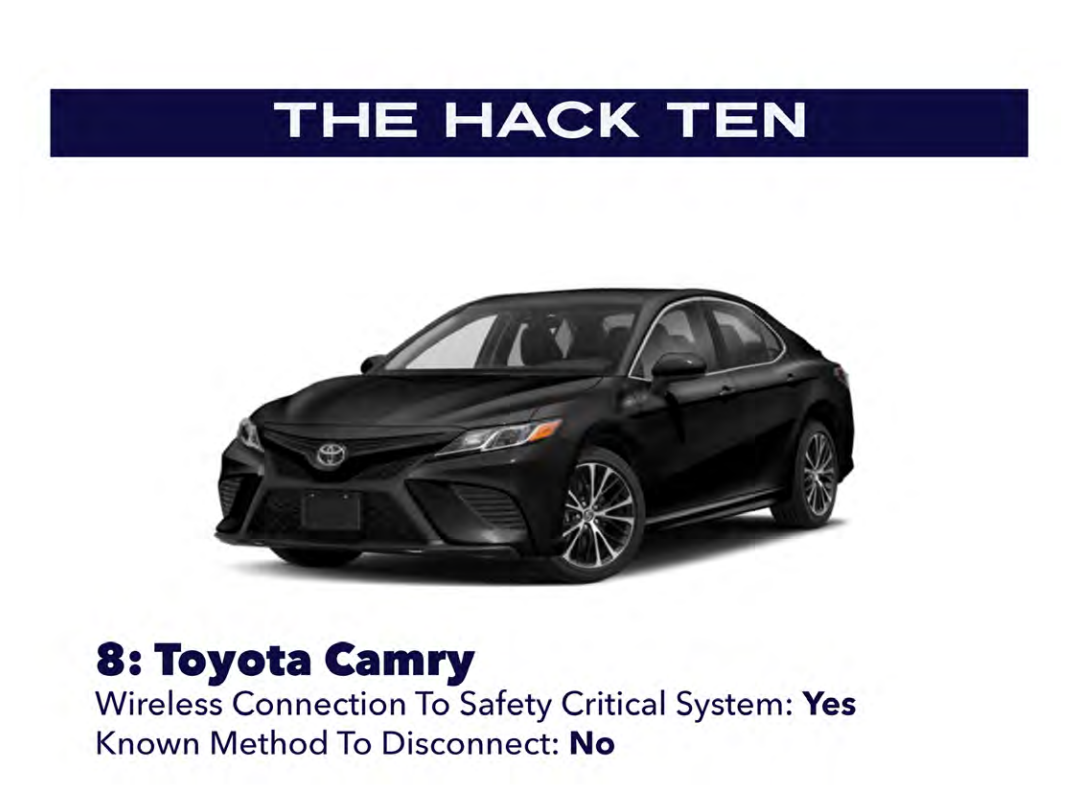
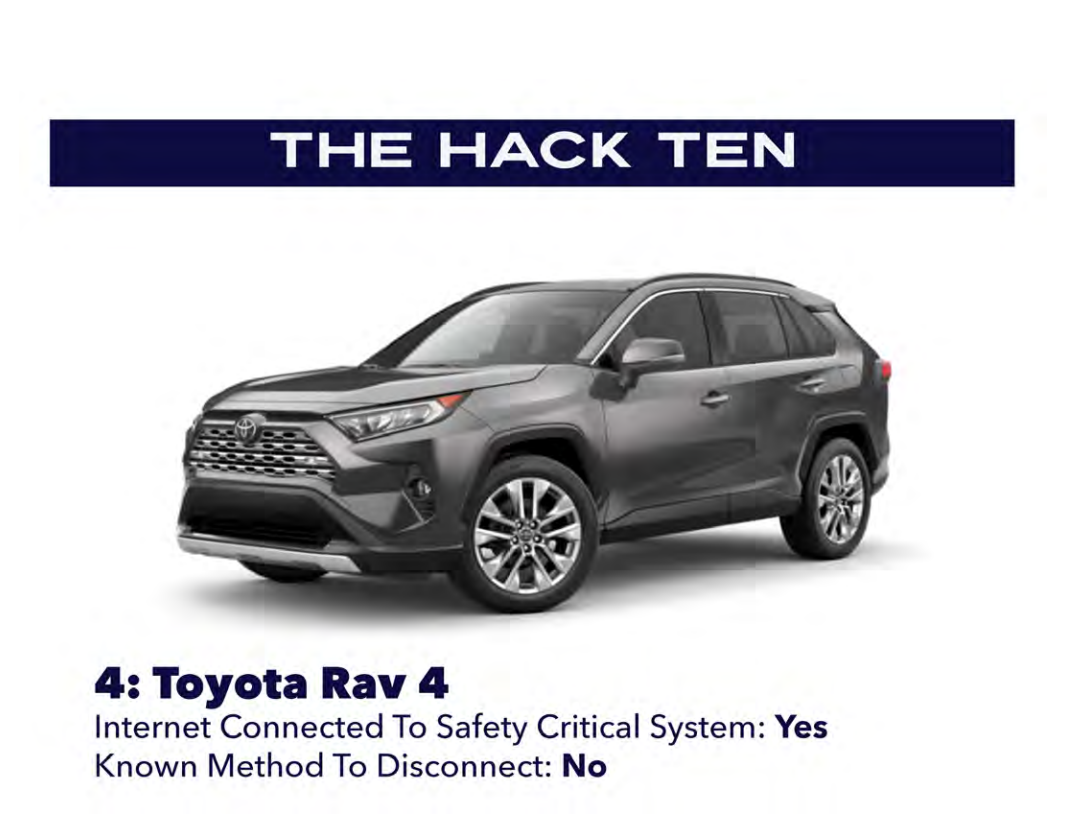
The XSE models have Remote Connect capabilities, while lower models such as the TRD and L do not (opens in new tab), according to advertisements. The connection in the 2020 Camry is very clear from its wiring diagram: two “Telephone” antennas connected to a “Telematics Transceiver” connected to CAN. This is textbook remote access to the car’s internal configuration.
Contradicting the wiring diagram, Steve Huberty, salesman at Schaumburg Toyota, said, “The car is not connected to the CAN bus but has remote capabilities triggered by a cellphone, such as remote start.”
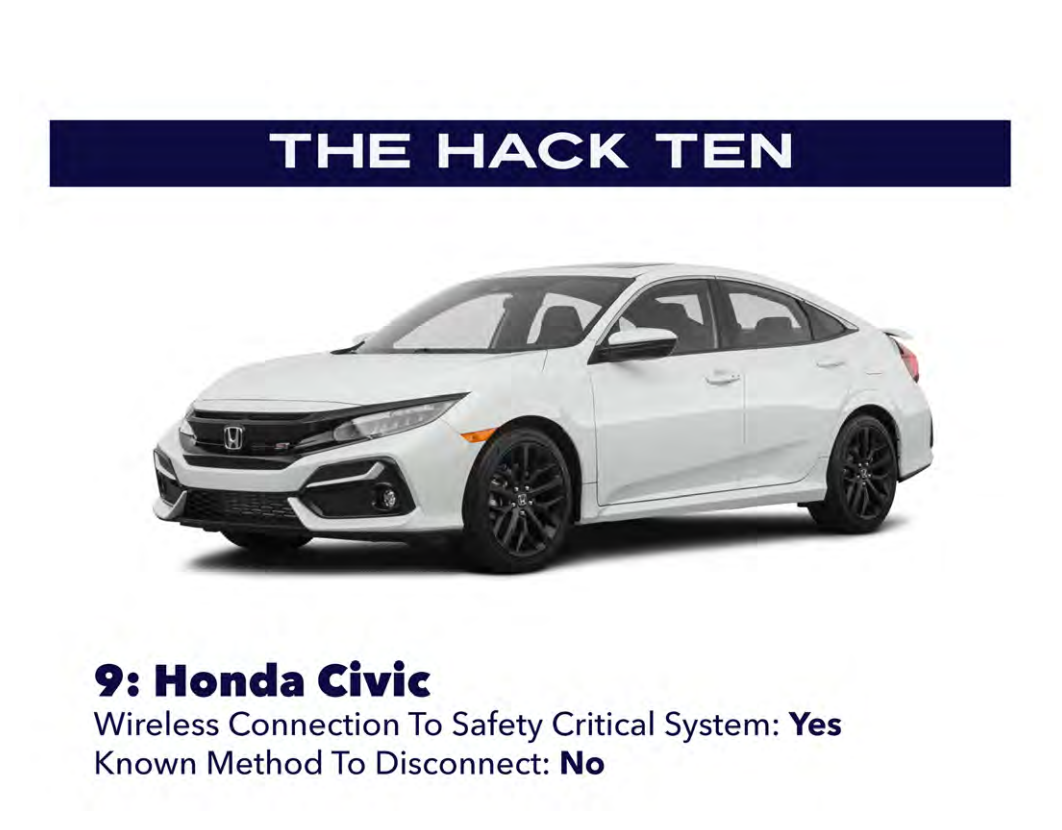
A Schaumburg Honda service department employee said their 2020 Civic (opens in new tab) is connected online via the HondaLink infotainment system through the CAN bus. Disconnecting it is not something the dealer would be able to do, according to the employee.
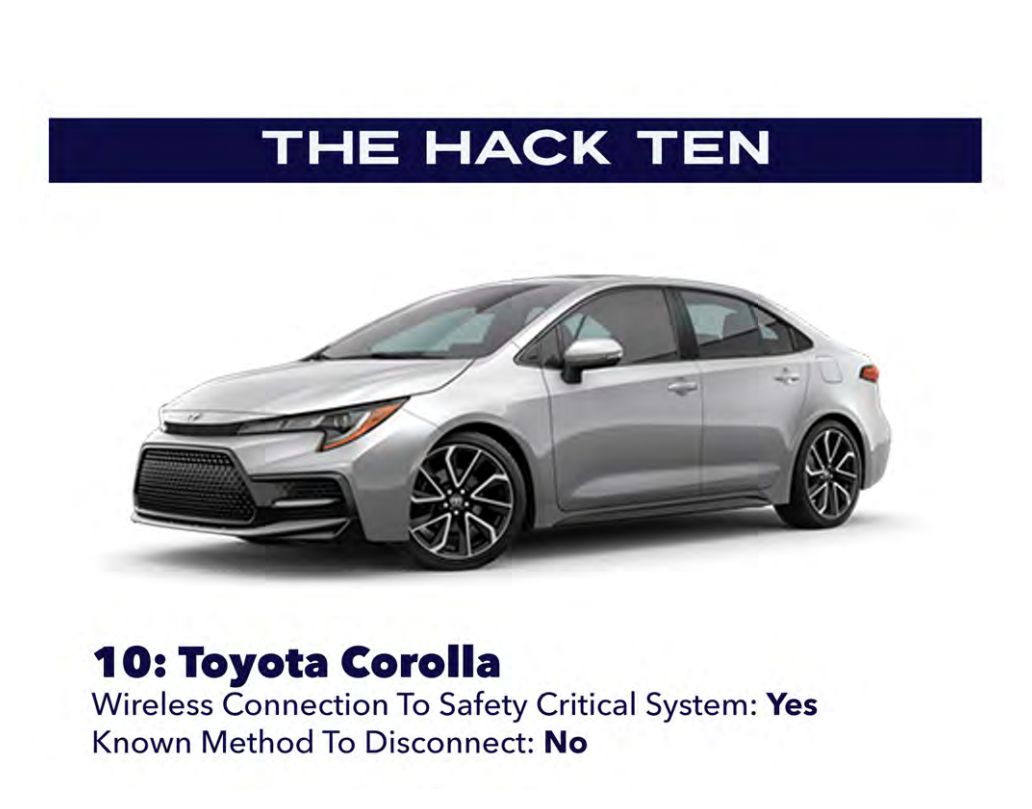
The 2020 model is not connected to the Internet, according to Schaumburg Toyota. Amenities such as remote start won’t be offered until 2021 models, according to the dealership.
The wiring diagram for the 2020 Corolla, however, shows two different “Telephone Antennas” — one on the roof and one in the instrument panel. These connect to a “Telephone Transceiver Assembly” which has a CAN connection. The upper-end 2020 Corolla models have “Safety Connect”, “Service Connect”, and “Remote Connect” services.
The owner’s manual refers to “Toyota Entune Service Connect” which “uses DCM [Digital Communications Module] to collect and transmit vehicle data…” and goes on to list several services. “Service Connect” includes the ability for Toyota to e- mail you “Maintenance Reminders” and “Vehicle Health Reports” based on information gathered digitally from the vehicle, indicating connectivity to the car’s the safety critical systems.
GRAND PRIZE:
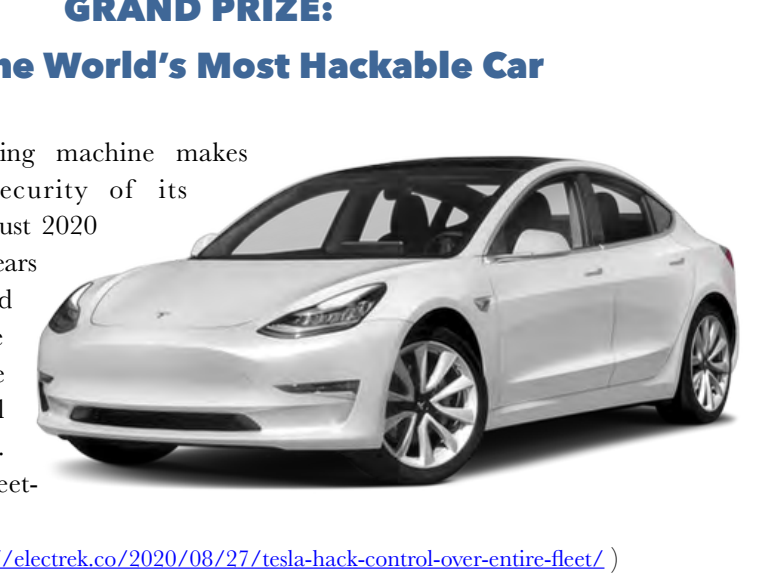
Tesla, The World’s Most Hackable Car
While Tesla’s marketing machine makes claims about the security of its connected cars, in August 2020 we learned that three years earlier Tesla’s fleet had been hacked and the hacker gained remote access to a safety critical system in every car.
This is known as a fleet-wide hack.
(Read the story at https://electrek.co/2020/08/27/tesla-hack-control-over-entire-fleet/ (opens in new tab)) Jason Hughes hacked Tesla’s servers to send “summon” commands to any car, given just its VIN. This meant he could move the cars forward and back a short distance — which is certainly a major safety concern.
The “white hat” hacker informed Tesla, which paid him a $50,000 bounty for the information and fixed it, but the public and regulators were never informed. TESLA SAFETY CLAIMS
- Engineered to be the safest cars in the world.
- Because every Tesla is connected, we’re able to use the billions of miles of real-world data from our global fleet – of which more than 1 billion have been driven with Autopilot engaged – to understand the different ways accidents happen. We then develop features that can help Tesla drivers mitigate or avoid accidents.
- Through over-the-air software updates, we’re able to introduce safety features and enhancements long after a car has been delivered, as well as release updated versions of existing safety features that take into account the most up-to-date real-world data collected by our fleet. https://www.tesla.com/VehicleSafetyReport (opens in new tab) FACTS Tesla’s Over The Air (OTA) updates have been hacked and are not safe.
- Consider Keen Labs Tesla Model S hack in 2016, in which they exploited a vulnerability in the over the air update system to take control of the car’s brakes, among other things. (See: https://keenlab.tencent.com/en/ 2016/09/19/Keen-Security-Lab-of-Tencent-Car-Hacking-Research-Remote- Attack-to-Tesla-Cars/ (opens in new tab))
- In spite of Tesla beefing up their cars’ security after the 2016 Keen Labs hack, Keen hacked Tesla cars again a year later, which proves that “fixing” a vulnerability doesn’t make a car secure; rather, it indicates that the vehicle is not secure by design, demonstrating there are probably more as-yet undiscovered vulnerabilities. ( https://electrek.co/2017/07/28/tesla-hack-keen-lab/ (opens in new tab))
- While OTA updates do have the positive potential Tesla mentioned, it was revealed in 2018 that Tesla abused the OTA update ability to release the Model 3 on an unsuspecting public before the software was fully tested — knowing they could fix the problem later. That resulted in the May 2018 / Consumer Reports brake fiasco: https://arstechnica.com/cars/2018/05/ how-a-software-brake-upgrade-won-tesla-a-consumer-reports-endorsement/ (opens in new tab)
- Later in 2018, there was also a case in which a botched OTA update caused Tesla’s Autopilot to stop working, demonstrating that, even without hackers involved, OTA updates can be a liability as well as an asset: https:// jalopnik.com/tesla-autopilot-not-working-after-latest-over-the-air- u-1829018937 (opens in new tab) Tesla uses open source software with serious design deficiencies.
Tesla’s cellular connection can be hijacked, as Consumer Watchdog has shown in this new video demonstration: https://youtu.be/RgpmJ6OhPns (opens in new tab)